What is T2, TP2, and TU1?
What are the differences between TP2, T2, and TU1?
TP2 (Phosphorus Deoxidized Copper)
TP2 is Phosphorus Deoxidized Copper and is assigned a copper content within the national standards of 99.90%. During the smelting process to aid the welding performance of copper tubes, approximately 0.015% of Phosphorus is added. This is primarily used in products with frequent air conditioning welding since they are designed to avoid "hydrogen embrittlement" and are less complicated to weld compared to T2.
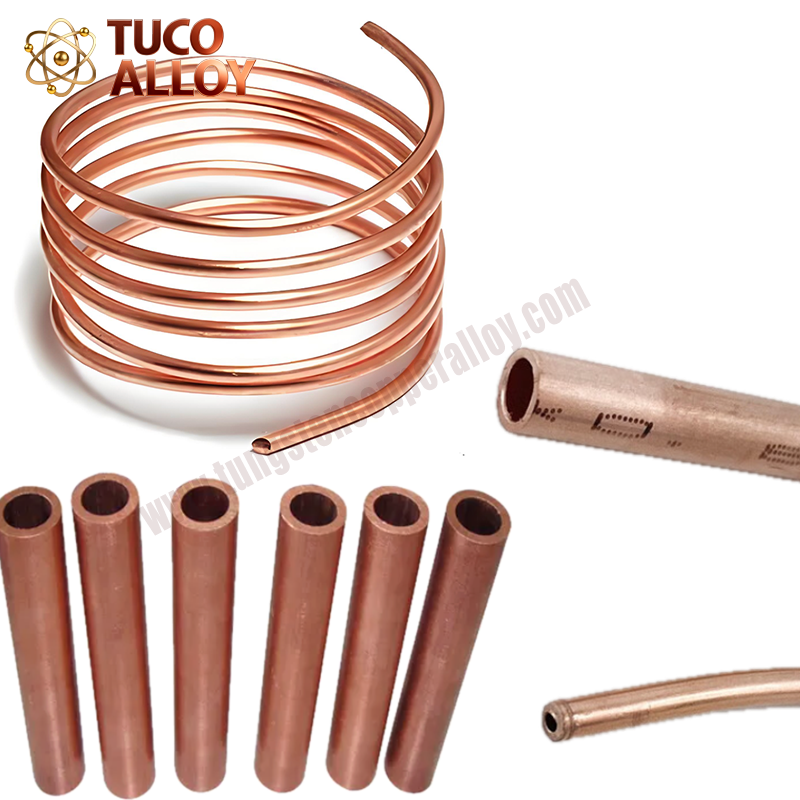
Since TP2 material has Phosphorus, it is less brittle, and TP2 is extensively used in the fabrication of air conditioning refrigerant connection pipes, gas circuit connection pipes for stoves, and electric heating pipes, among others.
T2 (Pure Copper)
T2 is a 99.90% + copper pure copper. When users require high conductivity from the material, T2 copper tubes are the preferred choice.
TU1 (Oxygen-Free Copper)
TU1 depicts oxygen-free copper, meaning copper with very low impurities, copper content up to 99.97% plus being free from oxygen. Also, impurities and oxygen are low, and phosphorus is also less than 0.002%. TU1 possesses very good electrical and thermal conductivity, notable ductility, superb workmanship, and resistance to corrosion, welding, and very low temperatures. Also, the uniformity enhancement is caused by the internal crystal grains, and ductility is improved by the decrease of the secondary phase particles at the grain boundaries. TU1’s uniformity of strain distribution during the processing of trumpet mouths is extremely beneficial, especially when compared to TP2. This means the processing of the trumpet mouthpiece will be more stable and reliable, resulting in safe sealing of the connection pipe. Because of the high production standards and costs, TU1 copper tubes have a high price compared to other purple copper tubes.
Chemical Properties of TP2, T2 and TU1 Copper
TP2 copper, also known as phosphorus-deoxidized copper, contains a small amount of phosphorus, which enhances its weldability and corrosion resistance. This type of copper is commonly used in applications where these properties are critical, such as in plumbing and heat exchangers.
Chemical Composition:
Copper (Cu): 99.90% min
Phosphorus §: 0.015% - 0.040%
Properties:
Excellent weldability
Good corrosion resistance
High thermal and electrical conductivity
T2 copper is a high-purity copper with minimal impurities, making it ideal for applications requiring excellent electrical conductivity. It is widely used in electrical and electronic components, as well as in the manufacturing of cables and wires.
Chemical Composition:
Copper (Cu): 99.90% min
Impurities: 0.10% max
Properties:
Superior electrical conductivity
Good thermal conductivity
High ductility and malleability
TU1 copper is another high-purity copper, similar to T2, but with even fewer impurities. This makes it suitable for applications that demand the highest levels of electrical and thermal conductivity, such as in high-end electronic devices and specialized industrial equipment.
Chemical Composition:
Copper (Cu): 99.95% min
Impurities: 0.05% max
Properties:
Exceptional electrical and thermal conductivity
Excellent ductility and malleability
High corrosion resistance
International Standards and Specifications for TP2, T2, and TU1 Copper
Chinese copper processing materials can be divided into four broad types: standard copper (T1, T2, T3, T4), oxygen-free copper (TU1, TU2, and high-purity vacuum oxygen-free copper), deoxidized copper (TUP, TUMn), and special copper containing small amounts of alloying elements (like arsenic copper, tellurium copper, and silver copper). Red copper, with electrical and thermal conductivity, is second only to silver, which is extensively used in the production of electrical and thermal equipment. In addition, red copper has a very high corrosion resistance to the atmosphere, seawater, and certain non-oxidizing acids (like hydrochloric acid and dilute sulfuric acid), alkalis, salt solutions, and various organic acids (like acetic acid, citric acid), and even in non-corrosive organic acids.
Name | Chinese Grade | Japanese Grade | German Grade | American Grade | British Grade |
Oxygen-free Copper | TU0 | C1011 | V10100 | C110 | —— |
No.1 Oxygen-free Copper | TU1 | C1020 | OF-Cu | C10200 | C103 |
No.2 Oxygen-free Copper | TU2 | C1020 | OF-Cu | C10200 | C103 |
Number One Copper | T1 | C1020 | OF-Cu | C10200 | C103 |
Copper No.2 | T2 | C1100 | SE-Cu | C11000 | C101 |
No.3 Copper | T3 | C1221 | —— | —— | —— |
No.1 Phosphorus Deoxidized Copper | TP1 | C1201 | SW-Cu | C10200 | —— |
Phosphorus Deoxidized Copper | TP2 | C1220 | SF-Cu | C10200 | —— |