Recommendations for Copper Alloy Materials with Good Electrical Conductivity and High Hardness
I. Prioritizing Electrical Conductivity (Recommended Options)
1. Chromium-Zirconium Copper (C18150/QCr1-0.15)
Electrical conductivity ≥80% IACS (80% that of pure copper); tensile strength at room temperature ≥545 MPa; hardness HRB 78–88; softening temperature ≥550°C; suitable for long-term operation at temperatures below 400°C.
2. Chromium Bronze (QCr0.5/QCr1)
Electrical conductivity can reach 80% IACS; maintains high strength below 400°C; softening temperature is twice as high as that of standard cold-worked copper.
3. Silver-Copper Alloy (CuAg0.1)
Contains 0.1% silver; electrical conductivity remains above 98% IACS (closest to pure silver); 50–80 °C improves resistance to high-temperature softening; stable for long-term use below 300°C; tensile strength 250–300 MPa.
II. Prioritizing Hardness/Strength
1. Beryllium Copper (C17200/QBe2)
After age-hardening, it exhibits a tensile strength of 1200–1450 MPa, a hardness of HV 370–430 (HRC 38–45), an electrical conductivity of 20%–28% IACS, and an elastic modulus of 128 GPa. It is non-magnetic, corrosion-resistant, and has a fatigue strength of 250–300 MPa.
2. Dispersion-Strengthened Copper (Alumina-Copper/Cu-Al₂O₃)
Features high electrical conductivity (up to 80%–85% IACS), a hardness exceeding HRB 84, and a softening temperature as high as 930°C. It has a tensile strength of 480–610 MPa and exhibits minimal hardness loss at elevated temperatures.
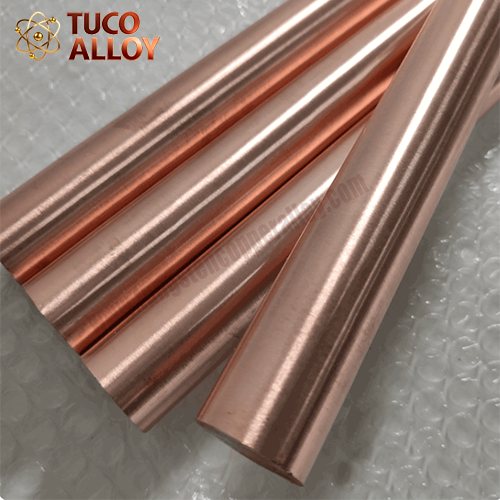
III. Selection Recommendations and Considerations
• For high electrical conductivity (approaching that of silver) combined with high hardness: Choose silver-copper alloy (CuAg0.1). It offers 98% IACS electrical conductivity and moderate strength, at a cost significantly lower than pure silver.
• For electrical conductivity above 80% combined with high hardness: Choose chromium-zirconium copper (C18150). It provides a well-balanced set of properties and the best value for money.
• For maximum strength/hardness, where electrical conductivity is sufficient: Choose beryllium copper (C17200). Its strength is more than double that of chromium-zirconium copper, though its electrical conductivity is only 20%–28% IACS.
• For high-temperature environments (>400°C): Choose dispersion-strengthened copper. It has a softening temperature of 930°C and exhibits minimal degradation in electrical conductivity and hardness at high temperatures.
• Beryllium copper contains beryllium, which is toxic; appropriate protective measures must be taken during processing. Chromium-zirconium copper and silver-copper alloys are safer to process.